A buyer once asked me a very simple question:
“What is the best wood for wooden toys?”
Beech?
Pine?
Juniper wood?
Plywood?
Or should we avoid all of those mysterious three-letter materials like MDF?
It sounds like a question with one correct answer.
Unfortunately, wood does not cooperate.
A baby rattle and a wooden play kitchen have completely different material requirements. So do a $5 puzzle and a premium pretend-play set.
And if someone tells me, “This toy is better because it is 100% solid wood,” my next question is always:
Better for what?
When I source wooden toys, I do not look for the most expensive wood. I look for the right combination of material, construction, durability, safety, appearance, sustainability, and cost.
For conventional wooden toys, I commonly work with juniper wood, pine, plywood, and MDF.
For natural baby products, beech becomes more relevant.
For children’s furniture and larger wooden products, rubberwood may enter the conversation.
The material should follow the product.
Not the other way around.
And that distinction can save buyers a surprising amount of money—and a few unpleasant emails after shipment.
Why Does Wood Selection Matter for a Wooden Toy Buyer?
When I receive a wooden toy quotation, the material column can look deceptively simple.
“Wood.”
“Plywood.”
“MDF.”
“Beech.”
Done.
But those few words can influence much more than the appearance of the finished toy.
Material selection can affect:
- Product strength
- Weight
- Surface quality
- Painting and printing
- Risk of dents
- Risk of cracking or warping
- Production consistency
- FOB cost
- Shipping cost
- Testing and compliance
- Perceived retail value
That is why I never evaluate a wooden toy simply by asking:
“Is it solid wood?”
Instead, I want to know:
Which material is used for each component, and why?
That is a much more useful sourcing question.
What Woods Are Commonly Used for Wooden Toys?
There is no universal winner.
In the wooden toy supply chain I work with, the most common materials for conventional toys are juniper wood, pine, plywood, and MDF.
Beech tends to have a more specific role, especially in natural baby products.
Rubberwood, meanwhile, is now more commonly seen in children’s furniture and larger wooden products than in conventional small toys.
Each material has advantages.
Each also has limitations.
Let’s look at them one by one.
When Should I Use Beech Wood?
Beech wood is hard, dense, smooth, and visually attractive.
But I would not describe it as the default material for conventional painted wooden toys.
I see it much more often in baby products such as:
- Wooden rattles
- Teething rings
- Grasping toys
- Natural sensory toys
- Baby gym accessories
- Other natural wooden baby products
There is a reason.
For these products, the natural appearance of the wood is part of the design.
The buyer is not necessarily looking for bright colors.
They are often looking for something clean, simple, tactile, and natural.
Because of this, beech baby products are commonly designed to retain the natural wood appearance rather than being covered with colored paint.
The smooth surface and visible wood grain become part of the product’s perceived value.
But there is something I care about more than the word “beech.”
The finish.
For a baby product, I pay close attention to the surface, edges, joints, and overall construction.
A premium wood species does not automatically create a premium toy.
A beautifully specified piece of beech with poor sanding is still poor sanding.
Wood does not get bonus points for having an expensive name.
Why Is Juniper Wood Common in Conventional Wooden Toys?
For conventional wooden toys, juniper wood is one of the solid-wood materials I encounter frequently.
It has a relatively hard texture.
That makes it useful for many small and medium-sized components that need to handle repeated play.
I may consider juniper wood for:
- Wooden blocks
- Toy vehicles
- Pretend-play accessories
- Stacking components
- Learning toys
- Small solid-wood parts
- Decorative wooden components
Compared with pine, juniper wood is generally harder.
That can be useful when a component is frequently picked up, dropped, pushed, stacked, or knocked against another component.
In other words, when children use it normally.
Children, by the way, are excellent durability testers.
They just refuse to follow laboratory procedures.
Another important point is that juniper wood does not need to be used throughout the entire toy.
A product might use juniper wood for small solid components, plywood for large panels, and MDF for a printed base.
That does not automatically make it lower quality.
Quite the opposite.
It may mean somebody actually thought about the construction.
What About Pine Wood?
Pine is another material commonly used in conventional wooden toys.
Compared with juniper wood, pine has a softer texture.
That difference matters.
A softer wood can be more susceptible to dents or surface marks, particularly on components that receive repeated impact.
But that does not mean pine is a poor material.
It means I need to use it in the right place.
Pine can offer advantages in terms of:
- Lower weight
- Easy machining
- Natural appearance
- Cost efficiency
- Suitability for certain larger components
When I evaluate pine, I therefore look at the product construction rather than judging the material in isolation.
If a small component is going to be dropped repeatedly, I may prefer a harder material.
If I am designing a larger component where extreme hardness is unnecessary, pine may be completely reasonable.
The correct question is not:
“Is pine good?”
It is:
“Is pine good for this component?”
That one extra sentence can make sourcing discussions much more productive.
Is Plywood Good for Wooden Toys?
This is where I occasionally surprise buyers.
Yes.
Plywood can be an excellent material for wooden toys.
It is also one of the most important materials used in modern wooden toy production.
Plywood consists of multiple layers of wood veneer bonded together.
Its construction makes it particularly useful for relatively large, flat components.
I commonly see plywood in products such as:
- Wooden play kitchens
- Dollhouses
- Activity boards
- Pretend-play sets
- Large learning toys
- Toy side panels
- Bases and shelves
- Larger wooden structures
Imagine a wooden kitchen.
Would making every large panel from solid wood automatically improve the product?
Not necessarily.
It could increase weight.
It could increase cost.
It could also introduce unnecessary challenges with dimensional stability.
Good-quality plywood can be a more practical engineering solution.
So when I see “plywood” on a quotation, I do not immediately ask the supplier to replace it with solid wood.
I ask three questions:
What plywood is being used?
Where is it being used?
Why was it selected?
Those answers tell me much more about the product than the words “solid wood” ever could.
Is MDF Suitable for Wooden Toys?
Now we arrive at one of the most misunderstood materials in wooden toys.
MDF.
Some buyers see those three letters and immediately think:
“Cheap.”
I do not.
MDF has some very useful properties.
It provides a flat, smooth, and consistent surface.
That can make it particularly useful for:
- Puzzle boards
- Printed toy panels
- Back panels
- Toy bases
- Decorative panels
- Certain pretend-play components
Think about a wooden puzzle with detailed printed artwork.
A stable and consistent surface can be very useful.
MDF can perform that job well.
However, MDF is an engineered wood product.
That means buyers need to understand the applicable requirements for the destination market, including relevant requirements concerning formaldehyde emissions where applicable.
For the United States, buyers working with composite wood products should understand the EPA TSCA Title VI formaldehyde emission requirements.
Resource: U.S. EPA – Formaldehyde Emission Standards for Composite Wood Products
So I do not ask:
“Does this toy contain MDF?”
and stop there.
I ask:
Where is the MDF used?
What specification is being used?
What is the destination market?
What testing or documentation is required?
That turns a material name into a proper sourcing decision.
What About Rubberwood?
Rubberwood is still important in wooden manufacturing.
But I see it playing a different role today.
For conventional small wooden toys, rubberwood is now used much less frequently in the supply chains I work with.
Instead, I see it more often in:
- Children’s tables and chairs
- Toy storage furniture
- Shelving
- Larger pretend-play furniture
- Larger wooden structures
- Children’s furniture components
Its strength and substantial feel can make it useful for these larger applications.
So if I am sourcing a small wooden puzzle, rubberwood probably will not be the first material I discuss.
If I am sourcing a children’s table and chair set?
Now we have a different conversation.
Again, the product decides the material.
Solid Wood, Plywood, or MDF: Which Is Better?
This is probably the wrong question.
I prefer:
Which material is better for which component?
Imagine I am developing a wooden pretend-play toy.
The smaller components may use juniper wood because I want a relatively hard solid wood.
Another component may use pine where a softer, lighter solid wood is sufficient.
The large side panels may use plywood.
A detailed printed board may use MDF.
That means one wooden toy could contain four different wood materials.
Is that bad?
No.
If the materials are correctly selected, it may actually provide a better balance of:
Strength + weight + appearance + stability + manufacturability + cost.
Now imagine I am developing a wooden baby rattle.
Completely different story.
I may prefer beech.
I may want to keep the natural wood appearance.
I may avoid colored paint covering the wood.
And I will pay particular attention to the surface finishing and safety of the finished product.
Then imagine I am developing children’s furniture.
Rubberwood may suddenly become much more relevant.
This is why I never start material selection with:
“I want everything in the same wood.”
I start with the product.
What Is a Quick Material Guide for Wooden Toy Buyers?
Here is the simplified version I would keep next to my RFQ sheet:
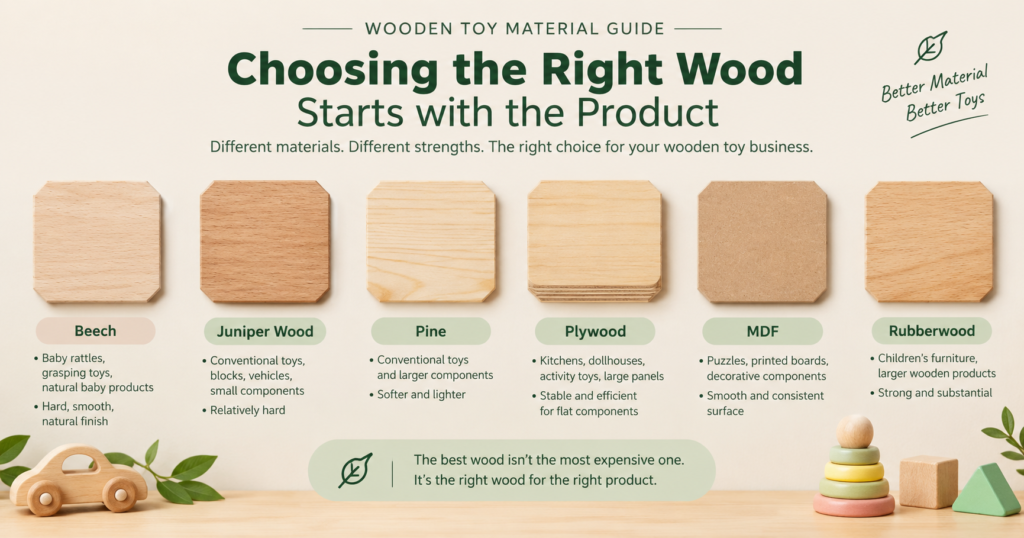
This is a starting point.
Not a law.
Every product should still be evaluated according to its design, age grading, construction, intended market, target price, and applicable safety requirements.
If a supplier recommends a different material, I do not reject the idea immediately.
I ask them to explain why.
A good answer can teach me something.
A bad answer can also teach me something.
Just not in the same way.
Why Does Wood Moisture Content Matter?
Here is one of the less glamorous parts of wooden toy sourcing.
Moisture.
Nobody puts “excellent moisture management” in giant letters on the front of a toy box.
But perhaps they should.
Wood is a natural material.
It absorbs and releases moisture depending on environmental conditions.
If moisture is not properly controlled during material storage and manufacturing, problems may appear later.
Possible issues include:
- Cracking
- Warping
- Shrinkage
- Expansion
- Loose joints
- Poor-fitting components
- Surface defects
And here is the frustrating part.
The approval sample may look perfect.
The problem might only become visible after mass production or after the goods have travelled thousands of kilometers by sea.
The USDA Forest Products Laboratory Wood Handbook provides detailed technical information about wood-moisture relationships and dimensional changes.
Resource: USDA Forest Products Laboratory – Wood Handbook
Do I expect every buyer to become a timber scientist?
No.
But I do expect a serious wooden toy manufacturer to understand moisture control.
That is part of working with wood.
Do I Need FSC-Certified Wood for Wooden Toys?
For many international buyers and retailers, FSC certification is an important sourcing consideration.
FSC stands for the Forest Stewardship Council.
Its certification system relates to responsible forest management and the traceability of forest-based materials through the supply chain.
Resource: Forest Stewardship Council – Official Website
But there is an important detail.
“FSC wood” is not a complete purchasing specification.
Buyers may encounter claims such as FSC 100%, FSC Mix, and FSC Recycled.
These claims have different meanings within the FSC system.
Resource: FSC – Understanding FSC Labels
So before production, I prefer to clarify:
Does the retailer require FSC?
Which FSC claim is required?
Does the finished product need an FSC label?
Does the packaging require an FSC claim?
What chain-of-custody documentation is required?
Does the retailer have additional sustainability requirements?
I want those questions answered early.
Not one week before shipment.
Compliance paperwork has an extraordinary ability to become “urgent” at 5:30 p.m. on Friday.
How Do I Check Wood Quality Before Mass Production?
I never judge wood quality from an Excel specification alone.
If the quotation says:
“Material: Juniper wood + plywood + MDF”
that is useful.
But it is not enough.
I want to see the actual sample.
And then I inspect it like a slightly suspicious customer.
I check:
- Surface smoothness
- Sharp or rough edges
- Splinters
- Visible cracks
- Warping
- Joint quality
- Component fit
- Paint coverage
- Printing quality
- Odor
- Moving parts
- Overall construction
For wooden toys, the finished product also needs to meet the applicable toy safety requirements for its destination market.
In the United States, children’s toys are subject to applicable CPSC requirements, including requirements related to ASTM F963.
Resource: U.S. Consumer Product Safety Commission – Toy Safety Business Guidance
For products placed on the EU market, buyers should also understand the applicable European toy safety requirements.
Resource: European Commission – Toy Safety
This distinction matters:
Good material does not automatically mean a safe toy.
The design, construction, coating, small parts, mechanical performance, chemicals, age grading, and intended use all matter.
I can buy excellent wood and still manufacture a terrible toy.
Talent works both ways.
Why Can Two Toys Made From the Same Wood Have Different Quality?
This is one of the biggest misunderstandings in wooden toy sourcing.
Imagine two factories both quote:
Juniper wood.
The first sample looks excellent.
The second does not.
How is that possible?
Because the wood species is only one part of the quality equation.
Finished quality can also depend on:
- Raw material grade
- Moisture control
- Material storage
- Cutting accuracy
- Sanding
- Edge finishing
- Drilling
- Gluing
- Painting
- Printing
- Assembly
- Production QC
This is why I would never select a wooden toy supplier simply because they use the “right” wood.
I want to understand how they control the material.
And how consistently they can reproduce the approved sample during mass production.
That second part is usually harder.
Why Can the Cheapest Wood Become the Most Expensive Choice?
Imagine two suppliers.
Supplier A saves me $0.15 per unit.
Supplier B is $0.15 more expensive but has better material control and more stable production.
I order 10,000 pieces from Supplier A.
Excellent.
I just saved $1,500.
Then inspection starts.
Some panels are warped.
Several components do not fit correctly.
The surface finish is inconsistent.
Now my $1,500 saving has made several new friends:
Rework.
Reinspection.
Replacement parts.
Shipment delays.
Customer complaints.
Markdown risk.
And my personal favorite:
The email with “URGENT!!!” in the subject line.
This does not mean I always choose the more expensive quotation.
I don’t.
It means I calculate total sourcing risk, not just unit cost.
Saving $0.15 is excellent.
Saving $0.15 and spending $0.50 fixing the consequences is less impressive.
What Should I Ask My Wooden Toy Supplier Before Ordering?
If I am evaluating a new wooden toy supplier, I would ask at least these questions.
1. What material is used for each component?
“Wood” is not enough.
I want the actual material breakdown.
2. Why was each material selected?
The supplier should be able to explain the construction logic.
3. How do you control wood moisture?
Especially for solid-wood components.
4. Is FSC-certified material available?
If required, clarify the exact claim and documentation.
5. How do you control plywood and MDF?
Ask about material specifications and applicable market requirements.
6. What happens between the approved sample and mass production?
This is a big one.
Sample quality is nice.
Production consistency pays the bills.
7. What in-process QC checks are performed?
I prefer preventing defects to discovering them during final inspection.
8. Which safety standards will the finished product be tested against?
This should match the destination market, age grading, product design, and intended use.
9. Can you suggest alternative materials if my target price changes?
A capable supplier should be able to value-engineer the product without blindly destroying its quality.
That is much more useful than simply saying:
“Sorry, best price.”
How Should I Balance Quality and Price?
I do not choose between quality and price.
I choose value.
There is a difference.
Suppose I am developing an entry-level promotional wooden toy.
I may need a very efficient material structure.
Now suppose I am developing a premium baby rattle.
Natural beech, tactile finishing, and perceived material quality may justify a higher cost.
Now suppose I am developing a large wooden play kitchen for a major retailer.
I may care most about structural stability, production consistency, packaging efficiency, shipping weight, and target retail price.
Three products.
Three sourcing strategies.
That is why I do not believe in one universal “premium material.”
Premium sourcing means choosing materials intelligently.
Sometimes that means beech.
Sometimes juniper wood.
Sometimes plywood.
And yes, sometimes it means MDF.
How Do I Balance Sustainability, Quality, and Cost?
This is where sourcing gets interesting.
Retailers want sustainability.
Consumers want beautiful products.
Buyers want competitive costs.
Factories want efficient production.
Logistics teams want lower weight.
And everyone wants the shipment on time.
Welcome to the toy business.
The solution is not to maximize one factor.
It is to balance them during product development.
If FSC-certified material is required, specify it early.
If natural wood is part of the product story, use it where consumers can actually see and feel it.
If a large structural panel performs better in plywood, evaluate plywood.
If a printed puzzle board needs a smooth and consistent surface, MDF may make sense.
If a frequently handled solid component needs greater hardness, juniper wood may be more appropriate than pine.
Good wooden toy sourcing is not about using the fanciest material everywhere.
It is about putting the right material in the right place.
Conclusion
There is no universal “best wood” for wooden toys.
Beech suits many natural baby products. Juniper wood and pine are useful for conventional toy components. Plywood and MDF solve important structural and surface needs, while rubberwood is more relevant to furniture and larger products.
For me, quality sourcing starts with one question:
What material makes the most sense for this product?